
Concert Ambulance and Medical Services
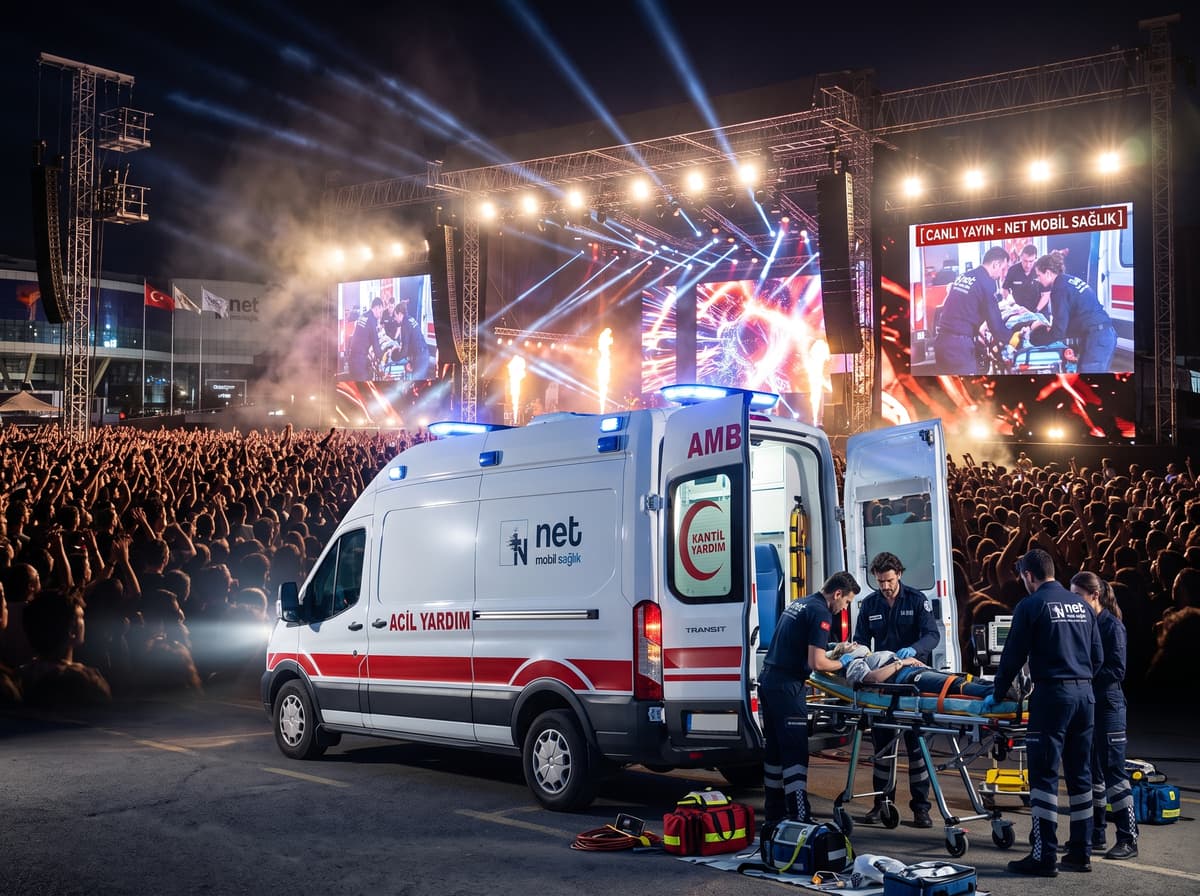
A concert ambulance service provides an ambulance and medical team on standby on site for audience members, performers and staff throughout concerts and live music events. Net Ambulans prepares the concert medical plan based on the layout of the venue, the expected audience size and the event's risk profile.
What health risks occur at concerts?
Concerts are events where large numbers of people gather in a limited space within a short time. This density can lead to a range of different health problems occurring at the same time. Common situations on site include:
- Fainting and dehydration due to standing for long periods, heat and crowding
- Crush injuries, falls and compression injuries in the dense front-of-stage area
- Health problems related to alcohol or drug use
- Flare-ups of chronic conditions such as asthma, diabetes and heart disease
- Dizziness or seizures triggered by loud sound and lighting effects
- Workplace accidents involving the technical crew during build-up and tear-down
Some of these risks can be prevented; others can only be managed in time by a well-prepared team. A good medical plan takes both into account.
Front of stage, backstage and evacuation
At concerts, the medical team is placed according to how the venue flows. The front-of-stage barrier zone is where the crowd is densest and where intervention is hardest. A team positioned behind the barrier in this zone works with security staff to quickly reach people pulled out of the crowd. On the backstage side, separate medical support can be planned for performers, dancers and the technical crew.
The ambulance position is chosen so that a patient who needs to be transferred can be taken out of the area without passing through the crowd. For this reason, keeping the ambulance approach route clear throughout the event is planned in advance with the organizer and the security team. The medical team's role in the emergency and evacuation plan is also clarified.
Indoor arena and open-air concerts
At indoor concerts, ventilation, the temperature inside the hall, stairways and narrow exit corridors are at the center of the plan. The first aid point is usually set up in the foyer or near the main entrance, while the ambulance is positioned near the building door best suited for transfers. At open-air concerts, sun, rain, cool night air and ground conditions come into play. To reach an audience spread over a large area, the number of foot teams and their assigned zones become more important. At stadium concerts, separate teams may need to be planned for the stands and the field.
On-site communication and incident logging
It is important for the medical team to communicate with security, production and event leads over a shared communication channel throughout the event so that response is not delayed. How and to whom security staff should report an audience member who has become unwell is clarified in the pre-event briefing. Every case treated on site is logged. These records are used both to pass on information when the patient is handed over to the hospital and for post-event reporting. For situations such as a lost child, someone separated from a companion in the crowd or an audience member who has forgotten their medication, the meeting point between the medical team and the event team is also set in advance.
What organizers should keep in mind
When planning medical services for a concert, sharing the event date, times, expected audience size and venue information early leaves enough time for the site survey and planning. Obligations regarding medical services may vary depending on the type and scale of the event and local regulations; you should check with the relevant authorities on this. Net Ambulans takes this information into account when preparing the plan.
For multi-day events or events with campsites, you can explore our festival medical services; for corporate parties and launches, our event ambulance services. Drawing on experience gained since 2015, Net Ambulans takes site survey and quote requests at 0212 912 51 84.
Concert medical plan step by step
- Site survey: The venue is visited or reviewed from plans; gates, the ambulance approach route, the front-of-stage area, backstage and first aid point locations are identified.
- Risk analysis: Factors such as audience size and profile, event duration, indoor or outdoor setting, weather and alcohol service are assessed.
- Team plan: The number of ambulances and staff, first aid point locations, foot team zones and hospital transfer routes are turned into a written plan.
- On site: The team takes up position before the gates open, communicates with security and production, and stays on duty until the area has cleared.
- Report: Numbers of interventions and transfers, along with risks observed on site, are reported to the organizer, with personal data protected.
Sample team and vehicle plan by audience size
The table below is a sample planning table; the final team and vehicle plan is determined by an event-specific risk assessment and the regulations in force.
| Event scale | Team | Vehicle |
|---|---|---|
| Up to 1,000 people | 1 doctor or paramedic, 1 emergency medical technician, 1 driver | 1 emergency ambulance |
| 1,000–5,000 people | 1 doctor, 2 paramedics or emergency medical technicians, foot first aid team, driver | 1–2 emergency ambulances, 1 first aid point |
| 5,000–20,000 people | 1–2 doctors, 4–6 paramedics or emergency medical technicians, front-of-stage and foot teams, on-site medical coordinator | 2–3 emergency ambulances, medical tent |
| 20,000 people and above | Multiple doctors, zone-based paramedic and emergency medical technician teams, on-site medical coordinator | 3 or more ambulances and multiple first aid points; the number is determined by risk analysis |
Frequently Asked Questions
How many ambulances does a concert need?
The number of ambulances isn't determined by audience size alone. Event duration, indoor or outdoor setting, weather conditions, alcohol service, front-of-stage density and distance to the nearest hospital are all assessed together. The table on this page offers a sample starting point; the final number is confirmed after the site survey and risk analysis.
When does the medical team arrive at the concert venue?
The team arrives before the gates open; it takes up its positions, tests communication channels with the security and production teams and checks the ambulance approach route. The assignment lasts until the event ends and the audience has left the area. Medical support can also be planned separately for build-up and tear-down days.
Can separate medical support be provided for backstage and performers?
Yes, on request, a separate first aid point or team can be planned for the backstage area. This arrangement allows the health needs of performers, dancers and the technical crew to be addressed without tying up the team in the audience area. The scope is determined by the scale of the event and the production team's requests.
What happens if there is a serious case at a concert?
The on-site team provides first aid to the patient and assesses their condition. If a hospital transfer is needed, the patient is taken by ambulance to an appropriate healthcare facility using the predetermined approach route. The plan also covers how medical support for the area will be maintained when an ambulance is dispatched for a transfer; coordination with 112 is arranged when necessary.
How far in advance should I book medical services for a concert?
We recommend reaching out as early as possible to leave time for the site survey, risk analysis and team planning. For large-scale events, starting discussions a few weeks in advance makes planning easier. Shorter-notice requests are also considered depending on team and vehicle availability; for information, you can call 0212 912 51 84.
Related Services
Contact Us
Don't hesitate to contact us for emergencies or more information about our services. We are at your service 24/7.