
On-Set Ambulance for Film and TV Productions
An on-set ambulance is a service provided during film, TV series, commercial and music video shoots, with an ambulance and medical staff on standby on location for the cast and crew throughout filming. Net Ambulans prepares the set medical plan based on the shooting schedule, the content of the scenes and the characteristics of the locations.
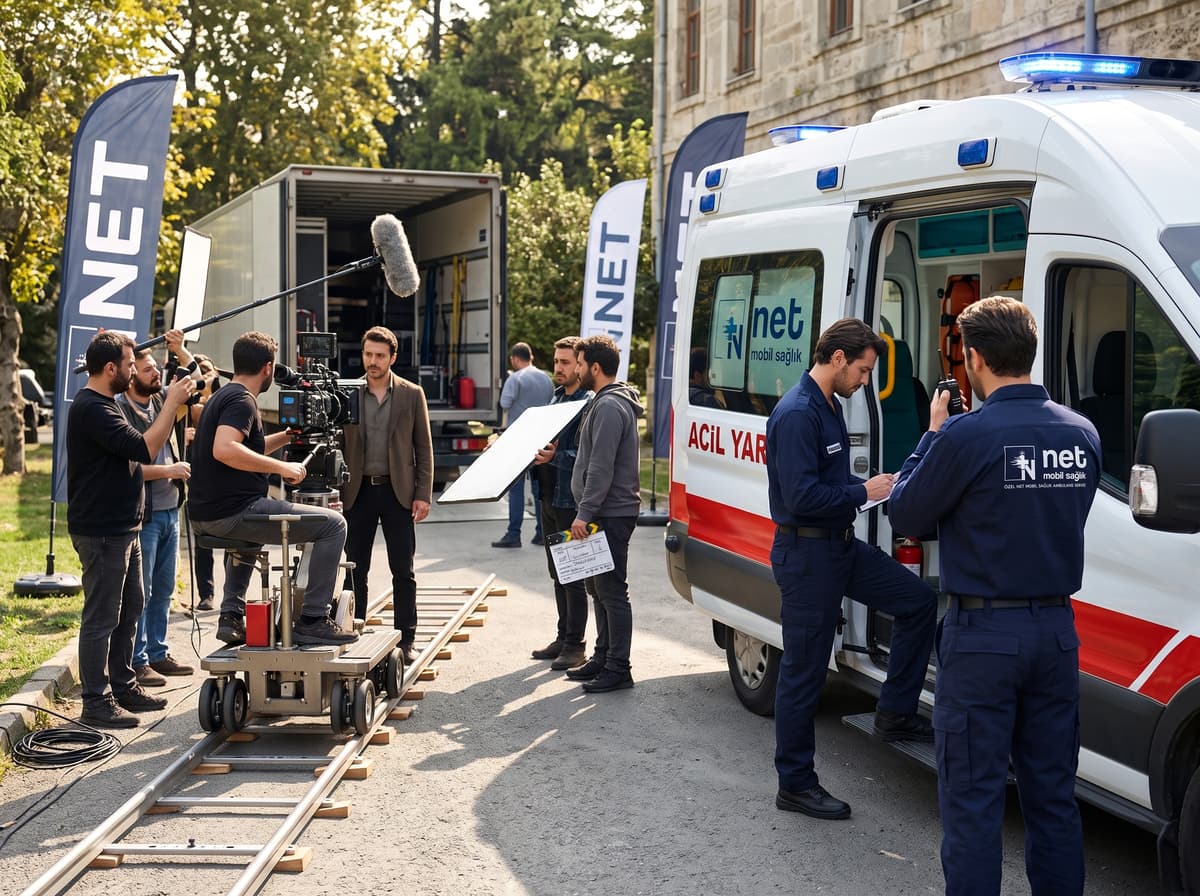
What are the health risks on set?
A shooting day often lasts many hours. The crew carries heavy equipment, works among cables and light stands, and frequently moves around during the day depending on the weather. This pace turns sets into workplaces with health risks of their own:
- Action and stunt scenes: Fight choreography, falls, vehicle scenes and jumps from height increase the risk of trauma.
- Night shoots: Fatigue, low visibility and cold raise the likelihood of both accidents and health problems.
- Location changes: At out-of-town, forest, coastal or mountainous locations, reaching the nearest hospital can take longer.
- Special effects: Scenes involving fire, water, smoke and explosion effects require additional planning.
- Long working hours: Waiting for long periods in the heat or cold can lead to dehydration, dizziness and flare-ups of chronic conditions.
The medical team during action and stunt scenes
The stunt coordinator and action team take their own measures to make the scene safe. The medical team's job is to be positioned so it can provide first response without delay if something unexpected happens. For this reason, before risky scenes the medical team holds a short briefing with the stunt coordinator to learn how the scene will be shot, the possible types of injury and the approach route for a response. During filming, the team waits at a point outside the camera's field of view but within quick reach of the scene.
Night shoots and location changes
During night shoots, everything outside the lit area stays dark, crew fatigue increases and the plan for reaching nearby healthcare facilities becomes even more important. On days when the location changes, the ambulance needs to move with the crew, and the nearest hospital information must be updated at each new location. Net Ambulans plans these moves in advance according to the shooting schedule.
The role of the set doctor
On days when risky scenes are shot, the set doctor leads the medical team. Before filming, the doctor assesses the scene with the stunt and action team and checks that equipment is prepared for the possible types of injury. If an injury occurs during filming, the doctor makes the initial assessment and gives the production a medical opinion on whether the actor or crew member can continue filming. If a hospital transfer is needed, the doctor makes the transfer decision and ensures the patient is handed over to the receiving team with a proper handover of information.
Crew health on long shooting days
Film crews often start early in the morning and work until late at night. This pace can lead to health problems not only during risky scenes but also during ordinary moments of filming. The medical team advises the production on fluid intake in hot weather, warming areas in cold conditions and rest options during long waits. Cast and crew members with chronic conditions can make a response easier by informing the medical team in advance, with their privacy respected. For shoots involving child actors, it is recommended that the contact details of parents or guardians be shared with the medical team and that the children's rest periods be observed.
Notes for productions
When planning medical cover, the shooting schedule, the location list and information about which days the risky scenes fall on should be shared early. Since health and occupational safety obligations may vary depending on the type of production and local regulations, it is advisable to consult the relevant authorities and your occupational safety specialist. For launches and corporate events outside the set, you can explore our event ambulance service. You can reach Net Ambulans 24/7 at 0212 912 51 84.
How does on-set medical cover work?
- Site survey: Shooting locations are inspected; the ambulance parking spot, access route to the set and the nearest hospitals are determined separately for each location.
- Risk analysis: Using the shooting plan and script breakdown, scenes involving action, stunts, heights, water and fire are flagged.
- Team plan: The team structure is set for each shooting day; a set doctor or additional staff are planned for risky scene days.
- On site: The team is on set before filming begins, meets with the stunt coordinator before risky scenes and stays on standby until filming wraps.
- Report: Interventions made during the day and observed risks are shared with the production with personal data protected.
Sample team and vehicle plan by type of shoot
The table below is a sample planning table; the final team and vehicle plan is determined by a shoot-specific risk assessment and the regulations in force.
| Event size | Team | Vehicles |
|---|---|---|
| Standard shoot | 1 paramedic or emergency medical technician, 1 driver | 1 emergency ambulance |
| Action/stunt scene | Set doctor, 1 paramedic or emergency medical technician, driver | 1 emergency ambulance, positioned close to the scene |
| Scene involving fire/water/heights | Set doctor, 2 paramedics or emergency medical technicians, driver; additional scene-specific equipment | 1–2 emergency ambulances; an additional first aid point if needed |
| Night shoot / out-of-town location | Team determined by scene type; shift plan for extended working hours | 1 emergency ambulance; hospital transfer route set in advance |
Frequently Asked Questions
Does the on-set ambulance stay on set for the entire shoot?
Yes, the on-set ambulance and medical team arrive on set before filming begins and stay until filming ends. On long shooting days and night shoots, shifts can be planned so that teams do not become fatigued. How medical support on set will continue if a patient needs to be transferred is also determined at the planning stage.
When is a set doctor needed?
A set doctor is usually planned for days when scenes involving action, stunts, heights, water or fire are shot, or for scenes with large numbers of extras. On standard shooting days, service can be provided with a paramedic or emergency medical technician. Which days a doctor will be present is decided together with the production based on the shooting plan and risk analysis.
When the location changes, does the ambulance move with the crew?
On shooting days with a location change, the ambulance moves to the new location together with the team and equipment. For each location, the ambulance parking spot, the access route to the set and the nearest healthcare facilities are determined in advance. At out-of-town locations, reaching a hospital may take longer, so the plan is prepared accordingly.
How is the medical team positioned during stunt scenes?
Before a risky scene, the medical team meets with the stunt coordinator to learn how the scene will be shot and the possible types of injury. During filming, the team waits at a point outside the camera's field of view but within quick reach of the scene. The ambulance's approach route is kept clear, and the vehicle is kept ready for a transfer if needed.
Do you also provide services for commercial and music video shoots?
Yes, on-set medical cover is not limited to films and TV series; it can also be planned for commercials, music videos and promotional film shoots. The same process applies to short shoots: the location is inspected, risky scenes are identified and a team suited to the shoot is planned. For information, you can call 0212 912 51 84.
Contact Us
Don't hesitate to contact us for emergencies or more information about our services. We are at your service 24/7.