
Transfer Ambulance: Inter-Hospital, ICU and Intercity Patient Transfer
A transfer ambulance service is a service for moving patients who cannot travel in a regular vehicle due to their medical condition from one place to another, accompanied by medical staff and in an ambulance with suitable medical equipment. Net Ambulans plans hospital-to-home, home-to-hospital, inter-hospital, intercity and airport-related transfers according to the patient's clinical condition. Requests are coordinated from our head office in Merter (Zeytinburnu) and taken by phone 24/7.
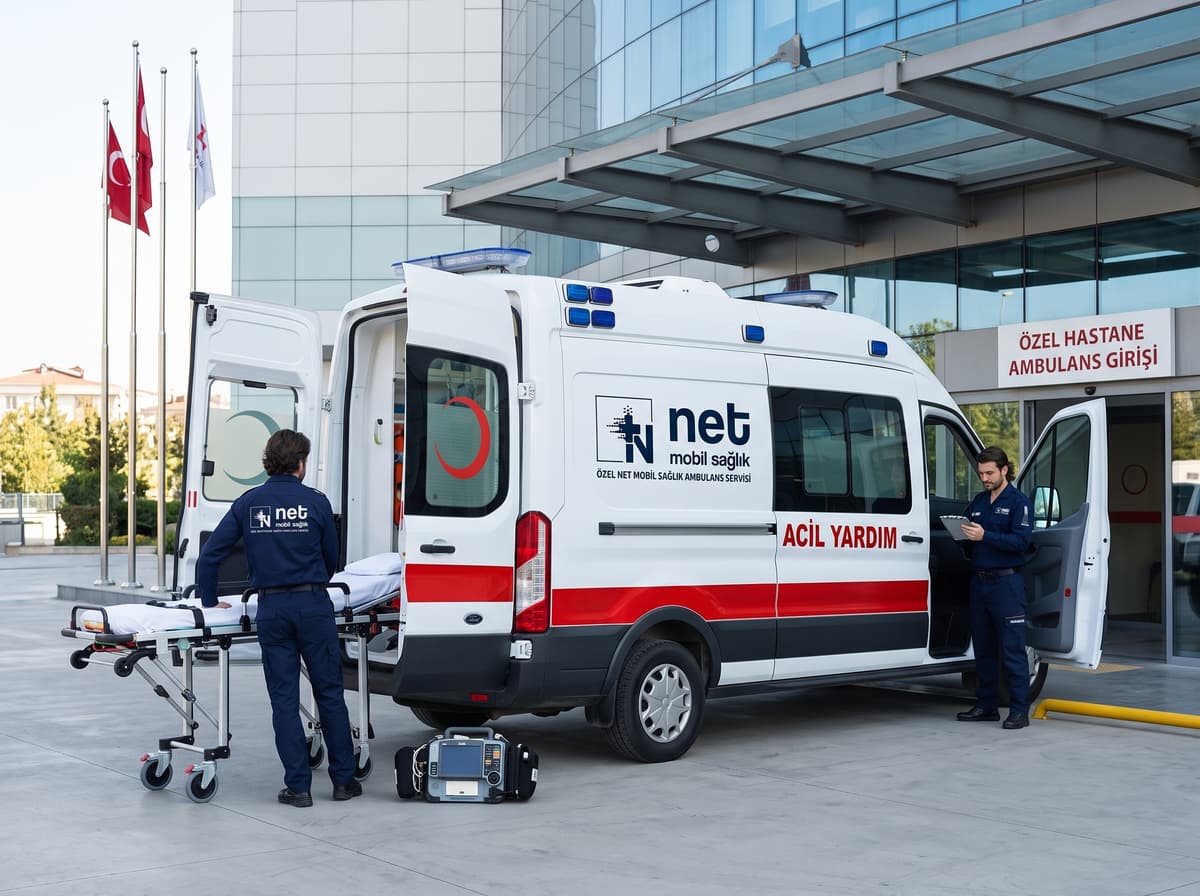
On this page you will find the types of transfer, the differences between ambulance types, how intercity and ICU transfers are prepared, and what information is requested from the family before a transfer. The same planning approach applies to short-distance transfers within Istanbul (which we describe by district and side of the city on our Istanbul patient transfer page); however, the longer the distance and the more serious the patient's condition, the broader the scope of preparation.
When is a transfer ambulance needed?
A transfer ambulance is generally used in situations that are not emergencies but require medical supervision. The most common reasons are that the patient cannot travel seated, needs oxygen support, must be carried on a stretcher or needs their vital signs monitored during the journey. Common examples include:
- Taking a discharged, bedridden patient home
- Round trips to the hospital for tests, dialysis, radiotherapy or a follow-up appointment
- Referral from one hospital to another hospital that can provide the required treatment
- Intercity transfer of a patient who will continue treatment in another city or return to their hometown
- Airport-related transfer of a patient arriving from or traveling abroad
- Moving to a nursing home, rehabilitation center or palliative care unit
What is the difference between ambulance types?
In Türkiye, road ambulances are classified in the relevant regulations according to their equipment and intended use. The general classification makes the following distinction:
- Patient transport ambulance A vehicle class defined for patients in stable condition who need basic supervision, a stretcher and oxygen during the journey.
- Emergency ambulance (red-striped): Carries more comprehensive equipment for advanced life support; suitable for patients who need monitoring or defibrillation, or who may need intervention on the way.
- ICU equipment: Equipment such as a ventilator and advanced monitoring that allows the level of care in the intensive care unit to continue on the road; planned for intubated patients or those who need close monitoring.
All ambulances in the Net Ambulans fleet are in the red-striped emergency ambulance class and are equipped for ICU transfers. This means that planned transfers such as discharges and appointment transfers, as well as ICU transfers of ventilator-dependent patients, are all carried out with vehicles at the same equipment level.
Equipment alone is not enough; who will be inside the vehicle matters at least as much as the equipment. Depending on the patient's condition, the team may include a physician, nurse, paramedic or emergency medical technician; a physician escort is planned according to the request and the patient's condition. The team composition is determined based on information obtained from the patient's attending physician.
Vehicle and team setup in our fleet
| Vehicle / transfer type | Equipment | Team | When |
|---|---|---|---|
| Emergency ambulance (ICU-equipped) | Ventilator, monitor, defibrillator, suction unit, oxygen system and stretcher. All ambulances in our fleet are in the red-striped emergency ambulance class and are equipped for ICU transfers. | Depending on the request and the patient's condition, a physician, paramedic or emergency medical technician (EMT) and a driver. | Planned transfers, discharges and inter-hospital transfers, ICU transfers and emergencies. |
| Physician-escorted ICU transfer | Carried out with the same ICU-equipped ambulance; the ventilator, monitor and enough oxygen capacity for the journey are prepared according to the patient's needs, and the physician stays with the patient throughout the transfer. | Physician, paramedic or EMT and a driver; the team composition is determined according to the patient's treatment needs. | Inter-hospital or intercity transfer of ICU patients who are ventilator-dependent or need continuous monitoring or drug therapy. |
How is an inter-hospital referral carried out?
In inter-hospital referrals, the transfer begins with an agreement between the two institutions. The sending hospital completes the patient's discharge or referral procedures, while at the receiving hospital the receiving physician's approval is obtained and it is confirmed that a bed and the relevant ward are ready. Setting off without this confirmation is not recommended, as it may leave the patient waiting at the destination. Net Ambulans schedules the transfer time to fit with the relevant units at both institutions; having the patient's discharge summary and latest test results, if available, with them during the transfer is helpful for the receiving team.
How is an intercity patient transfer prepared?
Intercity transfers can take hours, and the patient's needs may change during that time. For this reason, planning involves more than just mapping out a route. The amount of oxygen needed for the length of the journey, medication doses and times, fluid and nutrition needs, position changes and toilet needs are calculated in advance.
When the route is set, healthcare facilities along the way are also noted; this information is kept on hand so the patient can be taken to the nearest suitable hospital if their condition unexpectedly worsens during the journey. On long journeys, rest for the team and driver is also part of the plan. The cities we transfer patients to most often include İzmir, Bursa and Antalya. The hospital, care center or home at the destination is contacted in advance; the handover time, floor and entrance details are confirmed.
For documents, travel preparation and the flow of transfer day: Intercity patient transfer: process and preparation
How is an ICU patient transported?
The transfer of an ICU patient begins with an assessment between the sending and receiving physicians. The physician managing the treatment decides whether the patient is fit for transfer. Based on this decision, the necessary equipment and team are prepared; the ventilator settings to be used during the transfer and any ongoing infusion therapies are confirmed in advance.
On the day of the transfer, the team assesses the patient's current condition on site before taking over their care. The patient is switched to portable devices, connections are checked and vital signs are recorded throughout the journey. On arrival at the receiving unit, the patient is handed over to the receiving team verbally and in writing, together with the records kept during the transfer.
In ICU transfers, the moments of moving the patient from their bed to the ambulance and from the ambulance to the receiving bed are planned separately. For these moves, maintaining device connections and the airway, stretcher and elevator compatibility, and the division of tasks among staff are discussed in advance.
International patient transfer
Net Ambulans has the necessary authorization and capability to transfer patients from abroad to Türkiye or from Türkiye to another country; such transfers can be planned on request and are assessed individually in each case. In these transfers, the patient's medical condition, the requirements of the destination country, the airline's medical clearance procedures and the reception arrangements at the destination are assessed together. Net Ambulans's role in this process is to provide the road ambulance connection to the airport, medical staff escort where needed and the planning of coordination with the relevant parties. Each request is assessed in a preliminary consultation and finalized once a workable plan has been put together.
Airport transfer
In an airport transfer, the patient is picked up from home or the hospital and taken to Istanbul Airport or Sabiha Gökçen Airport, or a patient arriving by plane is picked up at the airport and taken to their destination address. The flight time, terminal information and how the patient will board the aircraft are obtained in advance. How far the ambulance can access depends on the procedures of the airport and the airline; for this reason, the process is confirmed with the relevant institutions in advance.
What you need to prepare before the transfer
While your request is being assessed, we ask for information such as the patient's diagnosis, current condition, medications, oxygen or device needs, the pickup and drop-off addresses, and the preferred date and time. The patient's ID document should be kept on hand; for inter-hospital referrals, the receiving physician's approval is required. When leaving the hospital, it is helpful to share the hospital's discharge summary with the team if one is available, but it is not mandatory. Details such as the building entrance, elevator size and floor are also important for planning stretcher carrying; there is no extra charge for carrying patients in buildings without an elevator.
Practical tips for patients' families
Transfer day can be tiring for both the patient and their family. The following preparations help the process go more smoothly:
- Gather the patient's medications, prescriptions and medical documents in a single bag.
- If the journey will be long, prepare comfortable clothes, a blanket and personal care items for the patient.
- Note down the name and phone number of the contact person at the destination.
- Also tell the team verbally about the patient's known allergies and the times of their last medications.
- 1 person can accompany the patient in the ambulance; decide in advance who will be the companion and let the team know.
If the patient's condition changes before the transfer date, for example if there is a fever, a new complaint or a change in medication, it is important to inform the team so the plan can be updated.
Drawing on experience gained since 2015, Net Ambulans takes transfer requests 24/7, including public holidays, at 0212 912 51 84. Same-day transfers can also be arranged subject to availability. Each transfer is treated as a separate plan based on the patient's condition and the family's needs.
The transfer process step by step
- Request and initial information: By phone at 0212 912 51 84, we learn about the patient's condition, the pickup and drop-off addresses, the date and any special needs.
- Assessment, equipment and team selection: The patient's clinical information is reviewed and, if necessary, discussed with the attending physician; the required equipment and team composition are determined; a physician escort is planned according to the request and the patient's condition.
- Planning and route: Oxygen and medication needs are calculated; the route, rest stops and healthcare facilities along the way are identified, and the handover time is confirmed with the destination.
- Transfer and monitoring: The patient is assessed on site and taken over; vital signs are monitored and recorded throughout the journey.
- Handover and reporting: The patient is handed over to the receiving team or the family with a verbal and written briefing; the transfer record is shared with the relevant parties.
Frequently Asked Questions
How is an intercity patient transfer planned?
First, we learn about the patient's current condition, diagnosis and the support they need. Then the team and equipment are determined, and the amount of oxygen and medication needed for the length of the journey is calculated. The route, rest stops and handover time at the destination are confirmed in advance. The cities we transfer patients to most often are İzmir, Bursa and Antalya.
Can a patient in intensive care be transported by ambulance?
The physician managing the treatment decides whether the patient is fit for transfer. Where it is deemed appropriate, the transfer is planned with our ambulances that have ICU equipment, including a ventilator and advanced monitoring, and with a medical team that includes a physician as needed. Ventilator-dependent patients can also be transferred. Vital signs are monitored throughout the journey and the patient is handed over together with the records.
Can a companion stay with the patient during the transfer?
Yes, one companion (1 person) can accompany the patient in the ambulance during the transfer. The companion sits in the seat shown to them in the vehicle so as not to restrict the team's space for attending to the patient. For ICU transfers, seating arrangements are finalized during planning according to the patient's condition. Simply let us know when you make the request that a companion will be coming.
What documents are required for a patient transfer?
The patient's ID document is sufficient for a patient transfer. For inter-hospital referrals, the receiving physician's approval is required. Sharing the hospital's discharge summary and current medication list with the team, if available, makes preparation easier, but it is not mandatory. Our team will share any details specific to the type of transfer with you during planning.
How does an ambulance airport transfer work?
The patient is picked up from home or the hospital and taken to Istanbul Airport or Sabiha Gökçen Airport, or picked up at the airport after landing. The flight time, terminal information and how the patient will board the aircraft are obtained in advance. Since the point the ambulance can access depends on airport and airline procedures, the process is confirmed with the relevant institutions in advance.
How is the cost of a transfer ambulance determined?
The cost varies depending on factors such as distance, the medical support the patient needs, whether a physician will be on the team, the duration of the transfer and waiting time. For this reason, instead of a fixed price, a personalized quote is prepared once the patient's condition and transfer details are known. For information, you can call 0212 912 51 84.
Related Services
Contact Us
Don't hesitate to contact us for emergencies or more information about our services. We are at your service 24/7.